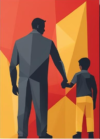
EVOFATHER · SERIES 2 · PART A
Your Grief.
The Man. The Loss. The Truth Nobody Prepared You For.
A Frank, Research-Backed Deep Dive Into the Widowhood Effect,
Delayed Grief in Men, Secondary Losses, and Your 10-Point Reality Check
By Simon | Evofather.com
📌 Permalink: evofather.com/widowed-father-grief-widowhood-effect-delayed-grief-men
Part 2A of the Evofather Series | A Standalone Deep-Dive Companion to Part 2
📌 SEO & Keyword Snapshot — This Post
Keyword Type
Keyword / Phrase
Search Intent
Primary
widowhood effect men fathers
Informational
Primary
delayed grief men after spousal loss
Informational / Emotional support
Primary
secondary losses after death of spouse
Informational
Primary
widowed father grief reality
Informational / Personal
Secondary
male grief patterns after partner dies
Informational
Secondary
single dad coping after wife death
Informational / Practical
Secondary
late fatherhood spousal bereavement
Informational
Long-tail
how does the widowhood effect affect fathers with children
Informational
Long-tail
why do men suppress grief after losing a partner
Informational
Long-tail
what are secondary losses widower father
Informational
Long-tail
grief reality check for widowed dads parenting alone
Informational / Emotional
LSI
complicated grief disorder men
Informational
LSI
survivor guilt widower
Informational
LSI
grief waves vs grief stages widower
Informational
📍 Series Navigation: • Part 1: “It Was Never Your Fault, Kid” → evofather.com/children-blame-themselves-divorce-tips • Part 2 Overview: “When the Pillar Falls” → evofather.com/loss-of-spouse-partner-father-children-grief • Part 2A (THIS POST): “Your Grief” → evofather.com/widowed-father-grief-widowhood-effect-delayed-grief-men • Part 2B (COMING): “Your Children’s Grief” → evofather.com/children-grief-losing-parent-fathers-guide
Introduction: Before We Talk About Them, Let’s Talk About You
There is a particular kind of man who reads articles like this one. He has already checked on the children. He has already put dinner on, answered the messages, made sure the school bag is ready for morning. He has already, in a dozen quiet ways, put himself last. And now, finally, in a window of rare stillness, he is asking — possibly for the first time — how he himself is actually doing.
If that is you, I want you to stop for a moment. Not to perform an emotion. Not to process on schedule. Just to acknowledge, man to man, that what you are carrying is real, it is enormous, and it deserves far more honest attention than our culture has ever been willing to give it.
I’m Simon. I separated at 45, divorced at 58, and remarried at 59. I have walked through the particular darkness that descends when the person who anchored your adult life is no longer there — and I have done it while children still needed breakfast and permission slips signed and someone to believe in them. There was no manual. So I wrote one. That’s what Evofather is. And this article — this deep, honest, research-backed deep-dive into your grief — is one of the most important things on this site.
We are going to cover four things in full: the Widowhood Effect and what it means for your physical survival; the Delayed Grief pattern specific to men and why it detonates when you least expect it; the Secondary Losses that most people forget to grieve entirely; and a frank, no-nonsense 10-Point Reality Check written from one father to another. No platitudes. No performative positivity. Just truth, research, and the genuine belief that you are more than capable of navigating this — with the right tools.
⚡ Before We Go Further — A Note on Professional Support: This article is deeply informational and written with the greatest care. But grief of this magnitude — spousal loss while parenting alone — is one of the most clinically significant life events a human being can experience. Please do not use this article as a substitute for professional grief support. It is a companion to it. 🔗 Find a qualified grief therapist near you: psychologytoday.com/us/therapists
Section 1: The Widowhood Effect — When Grief Becomes a Medical Emergency
The term sounds almost poetic. It is not. The Widowhood Effect is a clinically documented, statistically significant, physiologically real phenomenon in which bereaved spouses face a dramatically elevated risk of serious illness and death in the months immediately following their partner’s death. And for men — particularly older men with dependent children — the risk profile is among the most alarming in all of bereavement research.
This is not dramatic language. This is science. And it matters that you understand it, not to frighten you, but because understanding it transforms how seriously you take your own health in the aftermath of loss.
📊 The Research: What the Numbers Actually Tell Us
📊 Elevated mortality risk within 3 months of spousal loss
66% higher risk of dying — for both men and women
Source: JAMA Internal Medicine, 2013
📊 Gender differential in the Widowhood Effect
Men face a significantly higher and more sustained mortality spike than women
Source: Social Science & Medicine, Stroebe et al., 2001
📊 Cardiovascular risk post-bereavement
21x increased risk of heart attack in the 24 hours immediately following a partner’s death
Source: JAMA Internal Medicine — Buckley et al., 2010
📊 Depression prevalence in bereaved men
Widowed men are 2–3x more likely to develop major depression than their married counterparts
Source: British Journal of Psychiatry, 2014
These findings are drawn from multiple decades of convergent research. A foundational paper by Stroebe, Stroebe & Schut (2001) published in Social Science & Medicine remains the most-cited meta-analysis on gender differences in the widowhood effect, and it consistently identifies men as the higher-risk group — precisely because of the way male grief tends to be expressed, suppressed, or deferred.
The cardiovascular mechanism behind the Widowhood Effect has been extensively studied by Dr. Sunil Wimalawansa of Rutgers University, who identified the biological pathway through which acute grief triggers the stress hormone cascade — specifically elevated cortisol, adrenaline, and pro-inflammatory cytokines — that directly increases cardiac vulnerability.
🧬 Why Men Are Particularly Vulnerable
The heightened vulnerability of men to the Widowhood Effect is not arbitrary. It emerges from a confluence of social, behavioural, and structural factors that place widowed men at specific disadvantage compared to widowed women.
Risk Factor
What It Looks Like in Practice
Why It Matters
Social network dependency
Men’s social lives are often structurally organised through their partner — she maintained the friendships, the calendar, the social fabric.
When she dies, the social infrastructure collapses simultaneously with the relationship.
Emotional suppression norms
Cultural masculinity norms discourage emotional expression, vulnerability, and help-seeking.
Suppressed grief does not disappear. It accumulates — and eventually expresses itself through the body.
Reduced health-seeking behaviour
Bereaved men are statistically less likely to consult a GP, therapist, or specialist after spousal loss.
Physical and psychological symptoms go untreated longer, compounding over time.
Loss of domestic support
For many men of older generations, the partner managed domestic health — nutrition, medication reminders, medical appointments.
Self-neglect of basic physical needs accelerates in the months following loss.
Alcohol and substance use
Research documents elevated alcohol consumption in bereaved men as a primary coping mechanism.
Alcohol is a depressant, an inflammatory agent, and a sleep disruptor — all of which worsen grief outcomes.
Isolation and shame
Men are socialised to be self-sufficient. Reaching out for help feels like failure.
Emotional isolation is one of the strongest predictors of complicated grief disorder.
Parenting demands
Fathers with dependent children have reduced space for personal grief processing.
The constant demands of solo parenting create a grief backlog that eventually erupts.
💬 Simon Says: “I didn’t believe any of this applied to me until I ended up in a GP’s office six months after my loss, presenting with chest pain, insomnia, and the kind of fatigue that makes you feel like you’re walking through concrete. My doctor looked at me and said: ‘You’re grieving through your body because you haven’t been allowing yourself to grieve any other way.’ That sentence changed everything.”
✅ 8 Evidence-Based Actions to Protect Your Physical Health While Grieving
1.Schedule a full medical check-up within the first six weeks of your loss — specifically including cardiovascular markers, blood pressure, inflammatory indicators (CRP), and thyroid function. Do not wait until you feel something is wrong.
2.Tell your GP explicitly that you have recently been bereaved. This changes the entire clinical frame. ‘Bereavement’ on your file activates a different level of vigilance that is medically justified and appropriate.
3.Prioritise sleep above almost everything else in the first year. Grief-related sleep disruption is among the most physiologically damaging aspects of bereavement. If you are not sleeping, address this with your doctor directly.
4.Eat real food on a real schedule. Grief devastates appetite and executive function simultaneously — the two things required to feed yourself properly. Enlist help. Meal preparation services, community meals, or a trusted friend who cooks are not luxuries. They are health interventions.
5.Move your body every single day, even briefly. The evidence for exercise as a cortisol regulator, mood stabiliser, and sleep improver in bereaved individuals is overwhelming. Start with a 20-minute walk. Build from there.
6.Set a firm alcohol limit. Grief and alcohol are a dangerous combination with well-documented clinical outcomes. If you find yourself drinking to sleep, to numb, or to feel normal, speak with your GP immediately.
7.Maintain at least two social connections per week, even when isolation feels protective. Brief, low-pressure contact — a coffee, a walk, a phone call — maintains the social infrastructure that directly protects your immune and cardiovascular health.
8.If you experience chest pain, extreme fatigue, significant weight change, or persistent insomnia beyond three weeks — seek medical attention the same day. Do not rationalise these away as grief. They may be grief. They may also be something that requires immediate treatment.
📸 [Suggested Image: A man in his 50s sitting in a GP’s waiting room, honest expression, morning light. File: evofather-father-medical-grief.jpg]
Section 2: Delayed Grief in Men — The Detonator You Don’t Know Is Ticking
Here is what nobody tells you in the immediate aftermath of loss: the grief you are not feeling right now may be the grief that will hit you hardest. Delayed grief — the deferral of full emotional processing until weeks, months, or even years after a loss — is not only common in men. It is, arguably, the norm.
You organise the funeral. You manage the logistics. You make the phone calls and sign the documents and explain to the children and hold it together through the relatives and the casseroles and the well-meaning neighbours. And then, gradually, life demands its quotas and you return to work and the children return to school and the world continues to turn and everyone quietly signals that the acute phase is over. So you carry on. Because carrying on is what you do.
And then — sometimes six months later, sometimes twelve, sometimes at the second Christmas or the first birthday without them — it arrives. Not gently. Not in a form you recognise. Sometimes as rage. Sometimes as breakdown. Sometimes as a complete loss of motivation or meaning. Sometimes as a physical illness that appears from nowhere. The grief you deferred has been compounding interest in the dark, and it has come to collect.
🔬 The Science of Male Delayed Grief
Dr. Colin Murray Parkes, arguably the most influential bereavement researcher of the 20th century, identified ‘inhibited grief’ and ‘delayed grief’ as specific patterns in his landmark work, Bereavement: Studies of Grief in Adult Life (Routledge). He observed that men were disproportionately represented among those who showed minimal acute grief reactions but developed more severe complications later — including depression, substance abuse, and somatic illness.
A crucial 2019 meta-analysis in the Journal of Affective Disorders examining 48 studies on gender differences in grief found that men consistently demonstrated lower rates of acute emotional expression but significantly higher rates of complicated grief disorder (CGD) — the clinical syndrome in which grief remains unintegrated long after the loss. The authors identified masculine socialisation, specifically the suppression of vulnerability, as the primary mediating factor.
Neuroscientific research by Dr. Mary-Frances O’Connor, University of Arizona, author of The Grieving Brain (HarperOne, 2022), demonstrates that grief activates the brain’s reward circuitry — the same neural pathways associated with love, longing, and attachment. When grief is suppressed, these circuits remain in a state of perpetual, unresolved activation. Over time, this produces the physiological and psychological toll associated with complicated grief.
📍 The Male Grief Timeline: What Research Predicts
Time Period After Loss
What Delayed Grief Typically Looks Like in Men
0–3 months (Acute Phase)
High functionality, emotional numbness, logistical focus, ‘strong for the children.’ Grief appears minimal or managed.
3–6 months
Energy begins to deplete. Sleep disruption intensifies. The social support network starts to withdraw, assuming recovery is underway.
6–12 months (‘The Valley’)
The most commonly reported peak of grief in men who deferred. Sudden emotional flooding, depression, anger, questioning of purpose, identity collapse.
12–18 months
Without intervention: risk of complicated grief disorder, substance abuse, social withdrawal, or chronic physical illness. With support: integration and adaptation begins.
18–36 months
Oscillation between grief and forward movement. Identity rebuilding. New capacity for meaning-making, though grief remains present.
3+ years
Grief becomes integrated — part of the life story rather than the obstacle to it. Post-traumatic growth becomes possible and frequently documented.
⚠️ The Danger Zone: Research consistently identifies the 6–12 month window as the highest-risk period for bereaved men. This is when external support has typically withdrawn, when the anaesthetic of logistics has worn off, and when the full weight of the loss settles in — unannounced. If there is one period in which you most need proactive professional support, it is this one. 🔗 Grief therapy referral: psychologytoday.com/us/therapists
🚧 10 Signs Your Grief May Be Delayed or Suppressed
1.You have not cried — or rarely cried — since the loss, even though the relationship was close and loving.
2.You find yourself irritable, short-tempered, or chronically frustrated in situations that previously would not have affected you significantly.
3.You have thrown yourself into work, exercise, or parenting to a degree that begins to feel compulsive rather than constructive.
4.You feel emotionally flat or disconnected — not necessarily sad, but not quite present either.
5.You find it difficult to talk about your partner without either avoiding the topic entirely or feeling an emotion that seems disproportionately large for the context.
6.You have been using alcohol, food, screens, or activity to manage the edges of your days rather than sitting with them.
7.You are experiencing unexplained physical symptoms — fatigue, digestive issues, chronic headaches, reduced libido, recurrent illness — that have no clear medical cause.
8.Certain songs, places, or objects produce a grief response that feels entirely out of proportion to the moment.
9.You notice that certain anniversaries, milestones, or seasonal transitions hit you significantly harder than the day-to-day experience of loss.
10.People around you — children, friends, colleagues — have mentioned that you seem different, distant, or changed in a way you haven’t fully acknowledged.
💡 7 Strategies to Create Healthy Space for Your Grief
▸Name it when it arrives, even privately. When the emotion surfaces — while driving, in the shower, at 2am — say out loud or on paper: ‘I am grieving right now. This is what grief feels like.’ The act of naming activates the prefrontal cortex and reduces the emotional flooding that unacknowledged grief produces.
▸Schedule grief time deliberately. This sounds clinical, but it works. Grief researchers including Dr. George Bonanno recommend creating a specific, bounded time each day or week where you permit yourself to fully feel — listen to music connected to your partner, look at photographs, write. Containing grief in this way paradoxically reduces its intrusion into the rest of your life.
▸Write letters to your late partner. This is one of the most consistently effective grief-processing tools in clinical practice. It externalises the relationship, allows for unfinished conversations, and creates a private space where you are not required to perform strength for anyone.
▸Identify your specific grief triggers and approach them intentionally. Rather than being ambushed, plan for the first Christmas, the first birthday, the first holiday. Anticipatory acknowledgement dramatically reduces the severity of grief’s arrival.
▸Find one safe person to be fully honest with. Not to advise, fix, or reassure you — just to witness. A therapist, a trusted friend, a peer from a widowed father’s support group. The act of verbalising grief to another human being has documented neurological benefits that internal processing alone cannot replicate.
▸Read The Grieving Brain by Dr. Mary-Frances O’Connor (HarperOne, 2022). It is the most accessible, research-grounded explanation of what grief actually does inside the mind and body — and it is profoundly normalising for men who feel their grief does not match the expected template.
▸Engage a grief-specialised therapist. The distinction matters. Not every therapist has specific training in bereavement. Look for qualifications in Complicated Grief Treatment (CGT), Acceptance and Commitment Therapy (ACT) for grief, or the Dual Process Model. Resources: grieftherapist.com and psychologytoday.com/us/therapists
📸 [Suggested Image: A man writing in a journal at a kitchen table late at night, a mug of tea, warm lamp light. File: evofather-grief-journaling-man.jpg]
Section 3: Secondary Losses — The Grief Nobody Tells You Is Coming
When we speak about the death of a partner, we speak about the primary loss: the person themselves. The laugh you will never hear again. The hand you will never hold. The particular way they said your name. This loss is immense and obvious and culturally acknowledged, at least initially.
What is almost never spoken about — and what I believe causes some of the most persistent, confusing, and destabilising grief in bereaved fathers — are the secondary losses. These are the losses that cascade from the primary loss. The hundreds of small and enormous ways in which your life, your identity, your future, your routines, and your sense of self are also taken, alongside the person themselves. They arrive sometimes immediately, sometimes months later, sometimes years down the line — and they can feel entirely disproportionate to what seems like their actual size.
A man who barely wept at the funeral may find himself utterly undone by the realisation, in December, that he does not know what his children want for Christmas. Not because he doesn’t love them. Because she was the one who knew. That is a secondary loss. And it is as real as any other grief.
📋 The Complete Secondary Loss Inventory — For Widowed Fathers
Category
Specific Secondary Loss
When It Typically Surfaces
Identity
Loss of the role ‘husband’ or ‘partner’ — a central organising identity
Months 1–6
Identity
Loss of the shared narrative: ‘our story’
Year 1–2
Identity
Loss of the self as seen through your partner’s eyes
Year 1–3
Future
Loss of the retirement and later-life vision you built together
Months 6–18
Future
Loss of planned milestones — travel, achievements, grandchildren
Months 6–24
Future
Loss of the assumed framework: ‘we will grow old together’
Year 1–2
Practical
Loss of a co-parent and daily parenting decision partner
Immediate
Practical
Loss of domestic knowledge only they carried (accounts, contacts, routines)
Immediate–months 3
Practical
Loss of financial co-management and shared economic security
Months 1–6
Social
Loss of mutual friendships that dissolve after spousal loss
Months 3–12
Social
Loss of couple-identity in social contexts — events, gatherings, holidays
Months 3–12
Social
Loss of the social facilitator role (she/he organised the social life)
Months 1–6
Emotional
Loss of your primary confidant and emotional sounding board
Immediate
Emotional
Loss of the person who knew you most completely
Year 1–3
Emotional
Loss of physical intimacy, touch, and affectionate presence
Immediate–ongoing
Parenting
Loss of co-parenting alliance — ‘Did I do that right?’
Immediate–ongoing
Parenting
Loss of the parent your children most needed (maternal, paternal)
Immediate–ongoing
Parenting
Loss of backup — someone to call when you’re overwhelmed
Immediate–ongoing
Seasonal
Loss of shared family traditions and rituals at holidays
First year — each occasion
Milestones
Loss of shared witnessing: first steps, graduations, weddings
As milestones arrive
Faith/meaning
Loss of the belief that the world is fair or that planning matters
Months 3–12
Physical home
Loss of the sensory experience of a shared home — scent, presence, sound
Immediate–months 6
📌 Key Insight From Research: Dr. Therese Rando, in her seminal clinical work Treatment of Complicated Mourning (Research Press, 1993), identified secondary losses as one of the most underaddressed dimensions of bereavement in both research and clinical practice. She found that the accumulation of unacknowledged secondary losses is a primary driver of complicated grief disorder — and that therapeutic intervention specifically naming and processing each secondary loss significantly improved long-term outcomes. 🔗 Research Press: researchpress.com
💔 The Secondary Losses That Hit Widowed Fathers Hardest
Based on both research and the direct experience of bereaved fathers who have shared their stories through Evofather, these five secondary losses emerge as consistently the most destabilising for men parenting alone:
1. Loss of the Co-Parent
Parenting decisions are made every day — dozens of them, large and small. Which school? How to handle the bullying? Is this a fever we worry about? Should I let them go to that party? When your partner was alive, you had a sounding board. A second perspective. A check on your blind spots. Their absence in parenting conversations is not merely emotional — it is functionally disorienting. Many bereaved fathers describe a sustained anxiety about making parenting decisions entirely alone, a fear of getting it wrong with no one to course-correct.
Practical tool: Build a ‘Personal Parenting Advisory Board’ — two or three trusted people (a close friend, a family member, a therapist or school counsellor) who can serve as sounding boards for significant parenting decisions. This doesn’t replace your late partner. But it reduces the paralysing isolation of sole parenting.
2. Loss of Your Primary Confidant
Your partner knew you. Not the version you present to the world, but the actual you — the fears, the embarrassments, the half-formed thoughts you never quite finished, the dreams you’d told no one else. The loss of this specific intimacy — being known — is among the most consistently reported and least publicly acknowledged aspects of spousal bereavement in men. In its absence, many men describe a sense of becoming partially invisible, even to themselves.
Practical tool: Journaling, as discussed in Section 2, is one of the most effective bridges for this loss. So is a skilled therapist, not to process trauma, but to provide the specific experience of being fully heard by another human being. Many bereaved men report that this alone is genuinely restorative.
3. Loss of Physical Intimacy and Touch
This is the secondary loss that men are least likely to discuss and most likely to feel. Physical intimacy — not only sexual intimacy, but the daily touch of a relationship: the hand on the shoulder, the proximity in the kitchen, the warmth of sleeping beside someone — is physiologically regulating. It activates oxytocin, reduces cortisol, and signals safety to the nervous system. Its absence is felt in the body as well as the heart. Research documents elevated cortisol levels in recently bereaved men as a direct consequence of touch deprivation. This is not sentimentality. It is biology.
Practical tool: Physical connection with children — hugs, presence, shared physical activity — partly addresses this need. So does bodywork: massage therapy has documented benefits for bereaved individuals, including cortisol reduction and improved sleep quality. Do not dismiss this.
4. Loss of the Shared Future
One of the least-anticipated forms of secondary loss is the loss of the imagined future — the version of your life that you had planned, assumed, or simply always pictured. The retirement trip. Watching the children marry. Growing old in the same house. This future was not a fantasy; it was a framework through which you understood the meaning of your daily choices. Its sudden disappearance leaves a particular kind of grief that is difficult to name — a grief not for what was, but for what will never be.
Practical tool: Grief therapists call the process of rebuilding future orientation ‘meaning reconstruction.’ It doesn’t happen quickly, and it cannot be forced. But it begins with small acts of re-imagination: What matters to me now? What do I want my children to remember about this period of our lives? What does a good life look like from here? These are not exercises in moving on. They are exercises in moving forward — with the grief alongside you.
5. Loss of Your Social World
Research is unambiguous on this: the social world of bereaved men contracts sharply and often permanently in the year following spousal loss. Couple friendships dissolve. Social invitations dry up. The partner who managed the social infrastructure — who remembered the birthdays, maintained the friendships, organised the gatherings — is gone. And without that infrastructure, many bereaved fathers find themselves profoundly, invisibly alone in ways that are deeply at odds with their outward functionality.
The research of Dr. Carey Cooper, CBE, at Manchester Business School, on male social isolation post-bereavement, found that bereaved men with fewer than three active social connections were at significantly elevated risk of complicated grief and depressive disorders. Social reconnection is not a nicety. It is a clinical priority.
📸 [Suggested Infographic: ‘The Secondary Loss Web’ — visual showing primary loss at centre with secondary losses radiating outward in labelled spokes, colour-coded by category. File: evofather-secondary-loss-web.png]
Section 4: The 10-Point Reality Check — Man to Man
This is the part I have been building toward since the first paragraph. Not the research — though the research matters enormously. Not the strategies — though they are genuine and proven. This is the part where I sit across from you, as a man who has lived through something adjacent to what you are living through, and tell you the things I needed to hear and couldn’t find.
No softening. No silver linings until they’re earned. Just ten honest truths, written from one father’s heart to another.
Reality 1: You are allowed to be devastated.
Not brave. Not strong. Not ‘handling it well.’ Just devastated — fully, legitimately, without apology. The cultural pressure on men to modulate grief into something more dignified or functional is one of the most damaging forces in our emotional lives. You loved someone. They are gone. Devastation is the appropriate response. Allow it.
Reality 2: The grief will not arrive on schedule.
You may feel very little for months and then be completely undone by a stranger using your partner’s shampoo brand in the supermarket. Grief does not respect the timeline others place on your recovery. It does not arrive as sadness and depart as acceptance. It arrives in waves, in ambushes, in quiet moments and loud ones. Stop measuring your grief against other people’s expectations. Measure it only against your own honest experience.
Reality 3: Your children are watching how you grieve.
Not to judge you — to learn from you. They are observing whether grief is something to be ashamed of or something to be acknowledged. Whether pain is a sign of weakness or a mark of love. Whether the people we lose are forbidden topics or living presences in the stories we tell. How you grieve in front of your children is one of the most powerful lessons in emotional education you will ever provide. Grieve honestly. Grieve visibly, when appropriate. Grieve with them, when they will allow it.
Reality 4: Asking for help is not a betrayal of your strength.
The man who built the business, fixed the car, raised the children, held the family together — that man asking for help does not unmake any of those things. It adds to them. The most effective fathers I have ever encountered, the ones whose children speak of them with real pride and genuine love, are not the ones who suffered alone. They are the ones who modelled the courage to say: ‘I need support.’ Your children are paying attention. Show them what that looks like.
Reality 5: You will feel survivor’s guilt, and it lies to you.
The persistent inner voice that says you should have known sooner, done more, been different, saved them — it is not wisdom. It is grief dressed as logic. Survivor’s guilt is one of the most documented and most damaging aspects of spousal bereavement, and it requires direct, professional confrontation. A grief therapist trained in this specific pattern can help you distinguish genuine accountability from the guilt that grief manufactures to give itself somewhere to live.
Reality 6: You will have good days. They are not betrayals.
The Tuesday when you laugh at something ridiculous with your children and feel, for twenty minutes, entirely okay — that is not infidelity to your grief. It is not evidence that you didn’t love them enough. It is evidence that you are alive, that joy is still possible, that the person you lost would almost certainly want it to be. Grief and joy are not opposites. They are neighbours. You will learn to live in both rooms.
Reality 7: The second year is often harder than the first.
Everyone rallies in year one. The casseroles arrive. The calls come. The world accommodates your rawness. Year two, the world assumes you’ve recovered. The support withdraws. And you are left holding a grief that is, in many ways, heavier and more complex than the acute shock of year one — because now you know exactly what you have lost. You have lived every first. And the permanence, which was once abstract, has become entirely concrete. Prepare for year two. Plan for it. Resource yourself for it.
Reality 8: Your identity will need to be rebuilt, and that is not a crisis — it is an invitation.
You were a partner, a spouse, a half of a whole. And now you are not. This is a genuine identity rupture, and it deserves to be treated as such — with seriousness, with professional support, and with real patience. But inside that rupture is also something that men in midlife rarely encounter: a genuine invitation to ask who you are, now, on your own terms. Not as a replacement project. As an honest inquiry. Some of the most intentional, purposeful, alive versions of men I have ever encountered came through exactly this door.
Reality 9: Your children need you to heal — not to martyr yourself.
The father who sacrifices his own recovery entirely to his children’s needs is not performing the ultimate act of love. He is modelling self-abandonment. He is teaching his children that their wellbeing requires the erasure of the adults around them. Healing yourself — actively, unapologetically, with full resources — is one of the most generous things you can do for the people in your care. A present, functional, emotionally available father is worth infinitely more to your children than a self-sacrificing, depleted one.
Reality 10: There is a life of genuine meaning and even joy on the other side of this. I have seen it. So have thousands of fathers who have walked this road before you.
This is not a platitude. It is a researched, documented, clinically observed reality. The work of Dr. George Bonanno, Dr. Robert Neimeyer, Dr. Camille Wortman, and dozens of other leading bereavement researchers converges on this single, evidence-supported finding: the majority of bereaved individuals — with adequate support and the passage of time — achieve genuine adaptation and find renewed meaning in their lives. Not despite their loss. Often, profoundly, because of it.
Post-traumatic growth — the phenomenon of genuine psychological and spiritual development emerging from profound adversity — is not a fairy tale. It is real, measurable, and documented in bereaved fathers who chose to engage their grief honestly rather than bury it. The path there is not easy. But it is real. And it begins with this: the willingness to keep going.
“You were built for more than surviving this. You were built for the version of yourself that comes through it — the father, the man, the human being who looked at the hardest thing imaginable and decided, quietly, stubbornly, lovingly, to remain.” — Simon, Evofather
Your Grief Support Toolkit — Curated for Men
The following resources are specifically selected for bereaved fathers. Each has been included on the basis of evidence quality, accessibility, and direct relevance to the male grief experience.
Resource
What It Offers
Access
What’s Your Grief
Evidence-based grief education, articles, online courses, community
whatsyourgrief.com
Modern Widower
Peer community and resources specifically for widowed men
modernwidower.com
Soaring Spirits International
Widowhood community, events, peer connection
soaringspirits.org
GriefShare
Structured group-based grief recovery, faith-inclusive
griefshare.org
The Compassionate Friends
For bereaved parents; also supports widowed fathers
compassionatefriends.org
Psychology Today Therapist Finder
Search by specialty: grief, bereavement, men’s issues
psychologytoday.com/us/therapists
SADAG (South Africa)
24-hr crisis line, counselling referral, nationwide
sadag.org
Beyond Blue (Australia)
Men’s mental health resources including grief
beyondblue.org.au
Campaign Against Living Miserably (CALM)
UK-based men’s mental health, crisis support
thecalmzone.net
GriefNet
Online peer support community, multiple loss types
griefnet.org
Conclusion: The Bravest Thing You Will Do Today
You have just read one of the most honest conversations available anywhere on the internet about what it means to grieve as a man, as a father, as someone whose entire world has been restructured by loss. That took something. The willingness to sit with it, to read it to the end, to let it land — that is not nothing. That is the beginning of the kind of engagement with your grief that changes outcomes.
I want to say one final thing, and I mean it without any sentimentality: the fact that you are here, looking for answers, seeking to understand your own experience more clearly so that you can show up better for your children and for yourself — that is extraordinary. Not because grief is glamorous. Because most people don’t do this. Most people bury it and hope. You’re not doing that. You’re here.
Come back to Evofather. There is so much more to explore together — your children’s grief, the practical realities of solo parenting through loss, the question of rebuilding identity and intimacy, the long road toward a life that holds both grief and meaning simultaneously. Every article on this site is written with the same commitment: no performance, no platitudes, just the hard, honest, research-backed truth that men like us actually need.
You are not alone in this. We are figuring it out together.
🏠 Return to Evofather.com — your home for honest, research-grounded fatherhood support through life’s most demanding transitions.
📖 Continue the Series — Part 2B: “Your Children’s Grief” — coming soon to Evofather.
📚 Research References & Citations
All references link to original or reputable third-party sources. Evofather.com receives no compensation for recommendations.
1.JAMA Internal Medicine (2013) — Widowhood and Mortality: jamanetwork.com/journals/jamainternalmedicine
2.Stroebe, M., Stroebe, W. & Schut, H. (2001) — Gender Differences in Bereavement. Social Science & Medicine: doi.org/10.1016/S0277-9536(00)00110-8
3.Buckley, T. et al. (2010) — Cardiovascular Risk After Spousal Bereavement. JAMA Internal Medicine: jamanetwork.com
4.British Journal of Psychiatry (2014) — Depression in Bereaved Men: cambridge.org/core/journals/the-british-journal-of-psychiatry
5.Parkes, C.M. — Bereavement: Studies of Grief in Adult Life. Routledge (4th ed.): routledge.com
6.Journal of Affective Disorders (2019) — Gender Differences in Grief: sciencedirect.com/journal/journal-of-affective-disorders
7.O’Connor, M-F. — The Grieving Brain. HarperOne (2022): harpercollins.com
8.Bonanno, G.A. — The Other Side of Sadness. Basic Books (2009): basicbooks.com
9.Rando, T.A. — Treatment of Complicated Mourning. Research Press (1993): researchpress.com
10.Wimalawansa, S. — Biological Mechanisms of the Widowhood Effect. PubMed: ncbi.nlm.nih.gov/pmc/articles/PMC4940663
11.Kübler-Ross, E. & Kessler, D. — On Grief and Grieving. Simon & Schuster (2005)
12.Neimeyer, R.A. — Meaning Reconstruction After Loss. American Psychological Association (2001): apa.org
13.Wortman, C. & Silver, R. — The Myths of Coping With Loss. Journal of Consulting and Clinical Psychology (1989): apa.org/pubs/journals/ccp
14.Cooper, C. — Male Social Isolation Post-Bereavement. University of Manchester: research.manchester.ac.uk
15.What’s Your Grief — Evidence-Based Grief Education: whatsyourgrief.com
16.Modern Widower — Men’s Grief Peer Community: modernwidower.com
17.Psychology Today Therapist Finder: psychologytoday.com/us/therapists
18.South African Depression and Anxiety Group (SADAG): sadag.org
© 2025 Evofather.com | Written by Simon | All Rights Reserved
Disclaimer: This blog is for informational and educational purposes only. It does not constitute professional psychological, medical, or clinical advice. If you or someone you care for is experiencing a mental health crisis, please contact a qualified professional or crisis service immediately.
🌐 Evofather.com | 📧 simon@evofather.com | Part 2A — Evofather Series